
Graveyard Shift
12 of 13...I think

October 31st, 2025
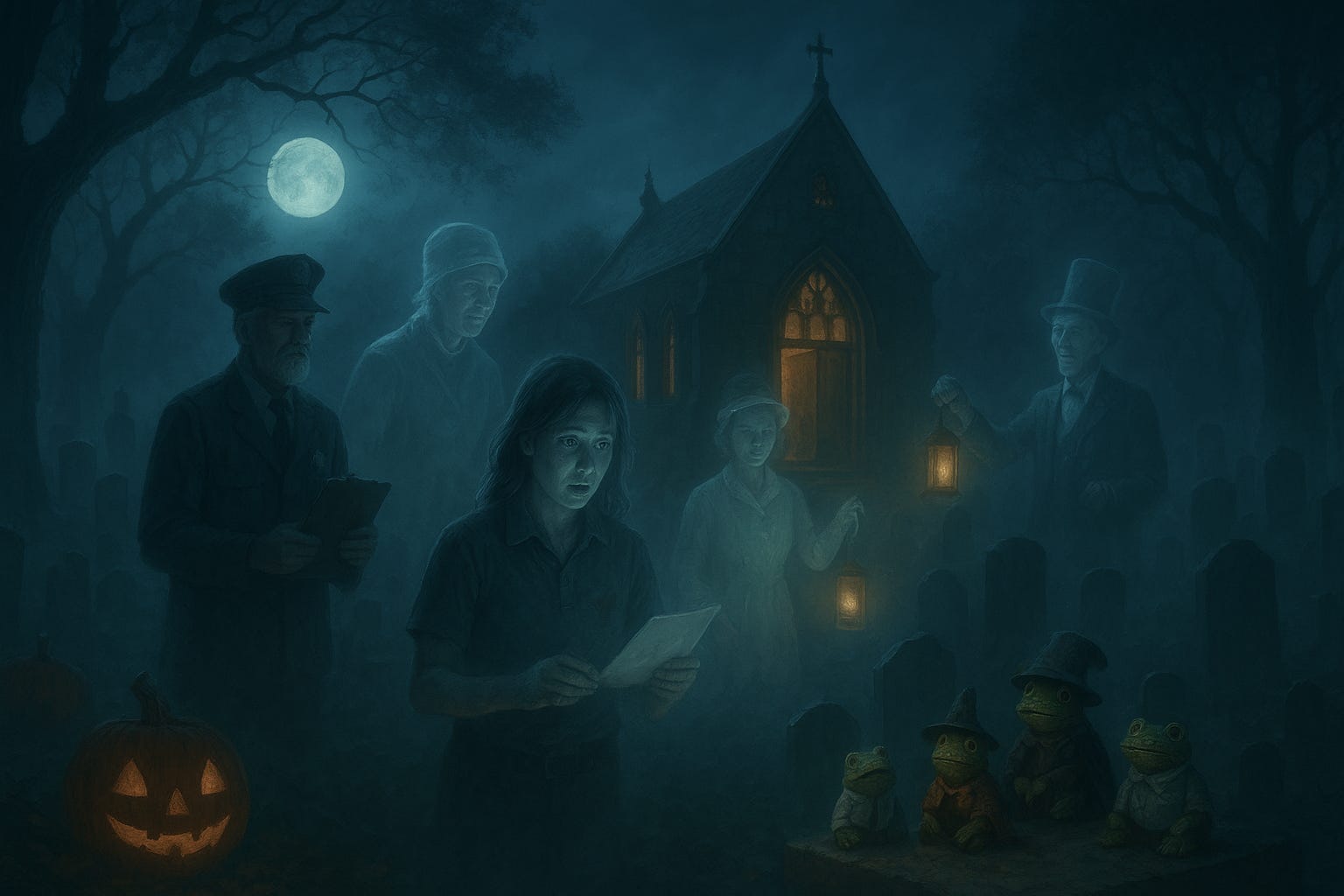
The new ghost materialized in the middle of the cemetery at 11:47 PM, which was exactly thirteen minutes before Frank Delaney’s scheduled rounds of the Victorian section. She was young, maybe twenty-five, wearing a security company polo shirt with a dark stain spreading across the collar. Her eyes were wild, panicked, darting around like a trapped animal.
“No no no no no,” she whispered, staring at her hands. They shimmered. Translucent. Wrong. “This isn’t... I was just... those kids were spray-painting the gates and I chased them and then...” She looked up at Frank, desperate. “What’s happening? Where am I?”
Frank Delaney had three rules for night shifts: keep the coffee hot, keep the clipboard organized, and never, ever try to understand why the Pemberton family insisted on leaving ceramic frogs on their grandmother’s grave. He’d learned that last one the hard way after spending two weeks trying to solve the “frog mystery” only to discover it was just what they did.
Right now, Frank was dealing with a situation that violated all three rules simultaneously. His coffee had gone cold an hour ago (though when he’d tried to taste it, it had tasted like air, but that was probably just stress). His clipboard had somehow gained an entire page of names he didn’t remember writing. And this panicking young woman was definitely more confusing than any ceramic frog.
“Easy now,” Frank said, using his calmest voice. The one he saved for lost tourists and confused mourners. “You’re at Pine Hollow Cemetery. You’re safe. Everything’s going to be fine.”
“Fine?” Her voice cracked. “I’m... I think I’m...” She couldn’t say it. The word stuck in her throat.
“Dead,” supplied a warm, echoing voice from behind Frank. “Yes, dear. You are. But it’s not as bad as it sounds.”
Marjorie Finch drifted out of the fog, her mid-century nurse’s cap perched at a jaunty angle, lantern swinging gently in her translucent hand. She’d been doing the midnight rounds since 1943, and she had the kind of calm competence that came from eighty-two years of practice.
The young woman made a sound halfway between a laugh and a sob. “Not as bad? I’m DEAD!”
“And you’re handling it very well,” Marjorie said. “Much better than Eldon did. He wandered into traffic seventeen times his first month.”
“I was disoriented,” called a voice from somewhere in the fog. A man in a tattered magician’s top hat emerged, twirling a spectral wand. Eldon Vale had died in 1955 doing a trick that went wrong, and he’d been practicing the same trick for seventy years, determined to get it right. “There’s a learning curve to being dead. Nobody explains the rules properly.”
“There are rules?” the young woman asked.
Frank cleared his throat and consulted his clipboard. This was familiar territory. He’d done this orientation dozens of times. Maybe hundreds. The faces blurred together after a while, but the routine never changed. “Yes. Simple rules. Everyone checks in at the punch clock at midnight. You do your rounds. You’re back before sunrise. That’s it. Easy.”
“Check in,” she repeated slowly. “At a punch clock. Because I’m dead. And I have a job now.”
“Technically you had a job before,” Frank pointed out. “Security guard, right? Same job, really. Just different hours.”
“I was a security guard for THREE WEEKS,” she said. “And then I died chasing vandals on Halloween night and now I’m...” She gestured helplessly at herself, at the cemetery, at the assembled ghosts. “This is insane.”
“First night’s always the hardest,” Frank said. He’d said this line so many times it came out automatic. “Come on. I’ll show you the punch clock. Once you check in, everything makes more sense.”
That was a lie. Nothing made more sense after checking in. But it made people feel better to think it would, and Frank had learned a long time ago that feelings mattered more than facts when you were dealing with the recently deceased.
They walked toward the chapel, the young woman stumbling occasionally as she adjusted to her new insubstantial form. The fog curled around their feet, thick and heavy. Jack-o’-lanterns flickered on newer graves. Plastic skeletons dangled from tree branches, rattling in a breeze that Frank couldn’t quite feel.
Halloween night. It always brought something extra to the cemetery. A charge in the air. A thinness to the veil between worlds. Frank had worked seventy-three Halloween nights at Pine Hollow (or was it seventy-four? the numbers got fuzzy sometimes), and every single one had been strange. But tonight felt different. Wrong. Like something was waiting.
His watch read 11:47. It had read 11:47 for the last twenty minutes. Frank tapped it irritably. The thing had been unreliable lately. He made a mental note to replace the battery.
They reached the chapel. Inside, the punch clock sat glowing faintly, humming like it was alive. Frank had never understood why a cemetery needed a punch clock. Someone from the county had installed it back in... when? The dates blurred. A long time ago. But rules were rules.
“Okay,” Frank said, gesturing to the clock. “Simple. Your card will appear. You slide it in. It goes ding. You’re official.”
The young woman reached forward tentatively. A card materialized in her palm, shimmering and translucent. Her name appeared on it in elegant script: Sarah Quinn. She stared at it like it might bite her.
“Go ahead,” Frank encouraged. “It doesn’t hurt.”
Sarah slid the card into the slot. Ding. The sound echoed through the chapel, clear and final. The ledger hanging on the wall glowed faintly, and a new line of ink appeared: Sarah Quinn, October 31, 2025, 11:47 PM.
She let out a shaky breath. “Okay. I did it. Now what?”
“Now you,” Marjorie said, looking at Frank.
Frank blinked. “Me?”
“You check in too,” Sarah said. “Right? Everyone checks in. You said so.”
“I already checked in,” Frank said automatically. “Hours ago. I’ve been on duty since six. I’m the supervisor. I don’t punch in with everyone else. I punch in at the start of my shift.”
“Frank,” Marjorie said gently. “When did you last punch in?”
“I...” Frank frowned. “This evening. When I arrived. Like always.”
“Show me your card,” Marjorie said.
Frank reached for the slot where employee cards were kept. His hand passed through empty air. He tried again. Same thing. His fingers felt like smoke, like he was made of the same fog that curled through the cemetery every night.
“The system’s broken,” Frank muttered. “I’ll file a report with Higgins. He handles this sort of thing.”
“I’m right here,” said a dry voice. Mr. Howard Higgins floated forward, a spectral ledger tucked under his arm. He’d been the county clerk in life and a stickler for proper procedure in death. “And the system is not broken. The system is functioning exactly as designed.”
He opened the ledger with meticulous care, licked a ghostly finger, and flipped through pages. “Let’s see. Finch, Marjorie. Checked in 1943, regular attendance, excellent marks. Vale, Eldon. Checked in 1955, seventeen traffic incidents, but otherwise satisfactory. Quinn, Sarah. Checked in just now.” He paused, adjusting his spectral spectacles. “Delaney, Francis. Checked in October 31, 1962. No checkout recorded. No subsequent check-ins recorded. Status: significantly overdue.”
The chapel went quiet. Even the punch clock’s hum seemed to fade.
“That’s not right,” Frank said. His voice sounded thin. “I check in every night. I’ve been checking in for...” He trailed off. How long? The math wouldn’t come. Numbers scattered like leaves.
Higgins turned the ledger around. Frank’s name glowed at the bottom of a yellowed page. His hiring date: October 15, 1962. His last punch-in: October 31, 1962, 11:47 PM.
Below it, in small, precise handwriting: Extended grace period granted. Cemetery requires custodian. Extension expires: October 31, 2025, 11:59 PM.
“I don’t understand,” Frank whispered.
“It’s quite simple,” Higgins said. “You died on Halloween night. Heart attack during your rounds. But the cemetery needed you, so it kept you. Gave you an extension. Sixty-two years, to be exact. The longest extension ever granted.” He glanced at his pocket watch. “Which expires in approximately eight minutes.”
Frank’s clipboard clattered to the ground. He didn’t pick it up.
“No,” he said. “No, that’s wrong. I’m alive. I’ve been working here for...” He stopped. The memories were there, but they felt strange. Thin. Like photographs left too long in the sun. He remembered Eisenhower on the radio. Kennedy’s assassination. The moon landing on a tiny black-and-white TV. Decades of presidents. Decades of faces. Too many. Far too many.
“When did you last eat?” Marjorie asked quietly.
Frank opened his mouth to respond, then closed it. He couldn’t remember. He drank coffee, didn’t he? From his thermos? Except... when had it last tasted like anything other than air?
“When did you last see your reflection?” Marjorie continued.
Frank’s hand went to the chapel window. He looked. There was nothing there. Just the faint shimmer of fog and moonlight. No face staring back.
“When did you last feel cold?” Marjorie asked. “Or hot? Or tired?”
Frank swayed slightly. The world tilted. Everything he’d been so carefully not-seeing for sixty-two years suddenly came crashing down at once. The way mirrors always seemed foggy. The way food never appealed to him. The way his watch had stopped at 11:47 and never started again. The way he never seemed to age while the world changed around him.
“I’m not,” he whispered. “I can’t be. I’m the night watchman. I’ve been the night watchman for...”
“Sixty-two years,” Eldon said softly. “We know, Frank. We’ve always known.”
Sarah, who’d been watching this entire exchange with wide eyes, spoke up. “You... you didn’t know you were dead?”
Frank shook his head mutely.
“How is that possible?”
“Denial,” Marjorie said. “The strongest force in the universe. Stronger than death, apparently. Frank loved this place so much, cared for it so deeply, that when his heart gave out, he just... kept working. And the cemetery let him. Because it needed him. Because we needed him.”
“But why did it end today?” Sarah asked. “Why now?”
Higgins consulted his ledger. “Because you arrived. Every extension requires a replacement. Someone who loves the cemetery enough to stay. Someone who cares enough to give their life for it.” He looked at Sarah. “You died protecting Pine Hollow from vandals on your first Halloween shift. The cemetery chose you. Just like it chose Frank sixty-two years ago.”
“I was only a guard for three weeks,” Sarah protested.
“Frank was only a guard for two weeks before he died,” Marjorie said. “Time doesn’t matter. Dedication does. You didn’t run when those kids were destroying the gates. You chased them even though you were scared. Even though your heart was failing. You cared. That’s all the cemetery asks.”
Frank felt something crack inside him. Not his heart. He didn’t have one anymore. But something deeper. The careful wall of denial he’d built brick by brick over sixty-two years.
“I need to see it,” he said hoarsely. “I need to see where...”
“I know,” Marjorie said. She picked up her lantern. “Come with me.”
They walked to the back corner of the cemetery, where the oldest graves huddled beneath gnarled oaks. Frank had avoided this section for as long as he could remember. Some instinct had always steered him away, found reasons to check other areas first, save this one for last, run out of time before he got there.
Now he understood why.
The grave was sunken, half-hidden beneath moss and fallen leaves. Unremarkable. Just another forgotten plot in a cemetery full of them. But when Frank knelt and brushed the leaves aside, he saw the nameplate:
Francis Delaney
1927 - 1962
He loved this place
Frank’s hand hovered over the stone. His fingers were translucent, glowing faintly in Marjorie’s lantern light. Not solid. Not real. Not alive.
“October 31st, 1962,” Marjorie said softly. “You were checking the grounds when your heart gave out. Right here, by this old oak. You didn’t suffer. You just... kept walking. Kept working.”
Frank traced the dates carved into stone. 1962. Sixty-two years ago. He’d been thirty-five years old. He remembered that Frank, young and eager, proud of his new job. He’d promised himself he’d take care of Pine Hollow. Keep it safe. Make sure nothing bad happened on his watch.
He’d kept that promise. For sixty-two years beyond his death.
“I really liked this job,” Frank whispered.
“We know,” Marjorie said.
“I liked the quiet. The order. Knowing that someone was watching over things.” His voice cracked. “I liked feeling useful.”
“You were useful,” Eldon said, appearing beside them with Sarah in tow. “You are useful. Present tense. You trained dozens of us, Frank. You kept things running. Hell, you kept me from wandering into traffic every week when I first showed up.”
“Seventeen times,” Frank said automatically. “I counted because Higgins made you fill out incident reports.”
“Exactly!” Eldon grinned. “See? You remember. You’ve been here the whole time. You’ve been part of this place. Part of us.”
Frank looked at Sarah. She was terrified, lost, probably feeling exactly what he’d felt sixty-two years ago when his heart had stopped and his body had fallen and his spirit had simply... continued walking.
“I’m sorry,” Frank said to her. “I’m sorry you have to go through this. It’s not fair.”
“Was it fair for you?” Sarah asked quietly.
Frank thought about that. Sixty-two years of night shifts. Sixty-two years of walking the same paths, checking the same gates, making sure the place he loved stayed safe. Sixty-two years of purpose.
“No,” he admitted. “But it wasn’t terrible either.”
The chapel bell began to chime. Midnight. Low and sonorous, the sound rippled through the fog. Frank felt it in his bones. Or in whatever ghosts had instead of bones.
“We need to get back,” Higgins said, appearing out of the mist. “The grace period expires in minutes. Frank must check in properly before midnight or...”
“Or what?” Sarah asked.
Higgins looked uncomfortable. “Or he becomes unmoored. Lost between states. The cemetery won’t be able to hold him anymore, but he won’t be able to move on either. He’ll simply... drift. Forever.”
Frank stood slowly. His legs felt weak, though he knew they weren’t really legs anymore. Just the memory of legs. The ghost of legs.
“Then I guess we should hurry,” he said.
They walked back through the cemetery together. The fog parted before them. Other ghosts emerged from their nightly routines, joining the procession. Frank recognized faces he’d seen for decades: the accountant, the teacher, the soldier, the magician. All of them moving toward the chapel. All of them watching him with something that looked like respect.
At the Pemberton grave, Frank stopped. The ceramic frogs were out in full force tonight. Dozens of them. All wearing tiny Halloween costumes. Witches, vampires, ghosts (which seemed redundant, but the Pembertons had never been conventional). One frog wore a tiny security guard uniform.
Despite everything, Frank laughed. “They never stop, do they?”
“Never,” Marjorie agreed. “Some things don’t need to make sense. They just are.”
They reached the chapel with two minutes to spare. The punch clock glowed, waiting. All the ghosts of Pine Hollow stood in a semicircle around it, silent and watching.
Frank looked at the clock. At the slot where his card should go. At the ledger glowing on the wall, his name flickering at the bottom of the page.
“I don’t want to,” he said quietly. “I don’t want to admit it’s over.”
“It’s not over,” Marjorie said. “You’re not leaving. You’re just... arriving. Officially. You’ve been in the waiting room for sixty-two years, Frank. It’s time to come inside.”
“What if I can’t?” Frank asked. “What if I try to punch in and nothing happens? What if I’m too late?”
“Then you’re too late,” Marjorie said simply. “But you’ll never know unless you try.”
Frank looked at Sarah. She’d stopped trembling. She was watching him with something that looked like understanding.
“Will you teach me?” she asked. “The rounds? The rules? All of it?”
“If I can,” Frank said. “If I’m still here.”
“You’ll be here,” Sarah said with unexpected certainty. “You love this place too much to leave.”
Frank reached for the punch clock. His hand shook. For a moment, nothing happened. His fingers passed through empty air, insubstantial as fog.
“You have to mean it,” Marjorie said. “You have to acknowledge what you are.”
Frank closed his eyes. Took a breath he didn’t need. And finally, after sixty-two years of denial, he let himself know the truth.
I’m dead. I died on Halloween night in 1962.
I’ve been dead for sixty-two years.
I’m Francis Delaney.
I was thirty-five years old.
I loved this cemetery.
I love it still.
I’m a ghost.
When he opened his eyes, a timecard had materialized in his palm. Yellowed. Brittle-looking. Dated October 31, 1962. His own handwriting on it, neat and careful: F. Delaney, Night Shift
His hand steadied. He slid the card into the slot.
For a moment, nothing happened.
Then: ding.
The sound echoed forever, bouncing off tombstones, reverberating through the fog, vibrating in the space where his heart used to be. The ledger glowed, lines of ink rearranging themselves. New words appeared: Status: Active. Position: Senior Custodian. Assignment: Training and Oversight.
Frank felt something shift inside him. The weight he’d been carrying for sixty-two years, the clipboard, the responsibility, the constant vigilance, all of it didn’t disappear. It just... settled. Found its proper place.
He looked down at his hands. They were fully translucent now, glowing faintly in the chapel lamplight. But they felt real. More real than they had in decades.
“Well,” he said after a long moment. “Shit.”
“Language,” Marjorie chided, but she was smiling.
From somewhere in the back, Eldon whooped. “He did it! Sixty-two years and he finally did it!”
The other ghosts began to applaud. It was a strange sound, like wind through leaves, but unmistakably joyful. Frank felt his face heat up, which shouldn’t have been possible since he had no blood to flow anywhere.
“Speech!” Eldon called. “Come on, Frank. You never give speeches. Now’s your chance.”
Frank cleared his throat. He looked at the assembled ghosts, at faces he’d known for decades without quite understanding what they were. What he was.
“I don’t really do speeches,” he started. “But... thank you. For waiting. For putting up with me being stubborn and oblivious for sixty-two years. I know I wasn’t the easiest person to work with.”
“You were terrifying,” Eldon said cheerfully. “You yelled at me for wandering off. Seventeen times.”
“You wandered into traffic seventeen times!”
“I was NEW!”
Despite everything, the chapel filled with laughter. Real laughter. The kind that came from people (or ghosts) who’d known each other long enough to find the humor in tragedy.
Frank smiled. “I just wanted to keep this place safe,” he said. “That’s all I ever wanted. And somehow, the cemetery let me keep doing that. Even after...” He gestured at himself. “Even after I should have stopped. So thank you. To the cemetery, I guess. And to all of you. For making this place feel like home.”
Marjorie stepped forward and hugged him. Her form was insubstantial, cold, but solid enough. Real enough.
“You did good, Frank,” she whispered. “Better than anyone could have asked.”
One by one, the other ghosts approached. Eldon clapped him on the shoulder. Higgins gave a formal nod. Even the vague, unnamed shapes drifted closer, offering what felt like approval.
Sarah watched it all with tears shimmering in her translucent eyes. “So this is it?” she asked. “This is what happens now?”
“This is what happens now,” Frank confirmed. “We keep watch. We follow the rules. We take care of the place.” He looked around at the assembled ghosts, at the chapel, at the punch clock still humming softly. “And we do it together.”
“I’m still terrified,” Sarah admitted.
“Good,” Frank said. “That means you’re paying attention. Come on. Let me show you the rounds. We’ve got about five hours until sunrise.”
They walked out of the chapel together, Frank and Sarah, with Marjorie’s lantern lighting the way. Behind them, the other ghosts dispersed to their nightly routines. Eldon headed toward the mausoleum to practice his card trick. Higgins floated off with his ledger. The others drifted into the fog, each following their own paths.
“Okay,” Frank said, pulling out his clipboard (which was now slightly translucent but still perfectly organized). “First rule: always start with the Victorian section. Those plots are high-maintenance. Second rule: if you see raccoons, don’t chase them. Trust me on this. Third rule: never, and I mean never, try to understand the Pemberton frogs.”
“The what?” Sarah asked.
Frank pointed. In the distance, the Pemberton grave gleamed with dozens of ceramic frogs in Halloween costumes. As they watched, one of the frogs in a vampire costume slowly tipped over.
“See?” Frank said. “Inexplicable. I spent two weeks trying to solve the mystery when I first started. Turns out it’s not a mystery. It’s just the Pembertons.”
Sarah laughed. It was a small, shaky laugh, but real.
They walked through the cemetery as the fog curled around their feet. Frank pointed out landmarks, explained procedures, showed Sarah which headstones tilted and which paths flooded and where the raccoons liked to dig.
“How long will I be here?” Sarah asked after a while.
“I don’t know,” Frank admitted. “Some people move on quickly. Marjorie’s been here since 1943. Eldon since 1955. I’ve been here since 1962, but I was... special case. You’ll know when it’s time to go.”
“And if I don’t want to go?”
Frank smiled. “Then you don’t go. Simple as that. Nobody makes you leave. You stay as long as you need to.”
They walked in comfortable silence for a while. The moon hung heavy and full overhead. Jack-o’-lanterns flickered their last. In the distance, the sounds of Halloween celebrations were fading. Children being called inside. Parties winding down. The living world settling into sleep.
“Frank?” Sarah asked quietly.
“Yeah?”
“Are you glad? That you finally know?”
Frank thought about that. Sixty-two years of denial. Sixty-two years of walking these paths without understanding what he was. It should have felt like a waste. It should have felt tragic.
But somehow it didn’t.
“Yeah,” he said finally. “I think I am. Because now I can actually help you. Before, I was just going through the motions. Now I know what I’m doing. Why I’m doing it. That matters.”
They reached the old oak where Frank had died. He stopped, looking at his grave with new eyes. The headstone was weathered but still legible. Someone had carved that. Someone had known.
“Did you?” Sarah asked. “Love this place?”
Frank nodded. “I did. I do. It’s strange, you know? I thought I loved it because it was my job. But it was the other way around. It was my job because I loved it. And somehow, the cemetery knew that. So it kept me.”
“Is that what happened to me?”
Frank looked at her. Really looked. She was young, scared, dead far too soon. But there was something in her eyes. A determination. A stubborn refusal to give up.
“You chased those vandals,” Frank said. “Even though you were scared. Even though you’d only been working here three weeks. You cared enough to risk your life. Actually risk it, not just theoretically. So yeah. I think the cemetery knew. And it chose you.”
Sarah was quiet for a moment. “I didn’t even think about it,” she said. “I just saw them spray-painting the gates and I got so angry. Like they were disrespecting something sacred. And I just... ran.”
“That’s how you know,” Frank said. “When you act without thinking because something matters that much. That’s love. Or close enough.”
They continued their rounds. Frank showed Sarah the Hutchison mausoleum (always locked, but always worth checking). The Victorian section (high-maintenance, prone to tilting). The newer plots near the entrance (well-kept, visited often). The columbarium (quiet, peaceful, rarely any issues).
By the time they circled back to the chapel, the first hints of dawn were touching the horizon. The fog began to thin. Shapes that had been solid started to shimmer, becoming translucent.
“What happens now?” Sarah asked.
“Now we fade until nightfall,” Frank said. “We’re tied to darkness, most of us. When the sun rises, we become less... present. Not gone, just quiet. Resting.”
“Will it hurt?”
“No. It’s actually nice. Like finally being able to sleep after a long shift.”
The other ghosts were gathering near the chapel, checking out at the punch clock. One by one, they slid their cards through. One by one, the clock dinged softly. The ledger recorded their departures.
Frank and Sarah waited until last. As the sun painted the sky in shades of pink and gold, Frank felt himself becoming lighter. Less substantial. The world of the living was waking up, and the world of the dead was going to sleep.
“See you tonight?” Sarah asked.
“See you tonight,” Frank confirmed.
They punched out together. Two soft dings echoing in the chapel. The ledger glowed, recording their shifts:
F. Delaney, October 31, 2025, 11:47 PM to 5:23 AM.
S. Quinn, October 31, 2025, 11:47 PM to 5:23 AM. Status: Satisfactory.
As the sun rose fully, Frank felt himself fade into the cemetery itself. Not gone. Just distributed. Part of the earth, part of the stones, part of the fog that would return when darkness fell.
For the first time in sixty-two years, he felt at peace.
The new guard arrived at 6:00 AM, yawning, clutching a coffee thermos. He’d gotten the emergency call at three in the morning: start immediately, previous guard didn’t show up. Strange way to begin a job, but the pay was good and the hours were... well, they were what they were.
The office trailer was unlocked. Inside, everything was neat. Almost too neat. Like someone had spent decades organizing it. On the desk sat a clipboard with detailed notes about the grounds: which sections to check first, which paths flooded, where the raccoons dug, which families left unusual items on graves.
At the bottom, in old-fashioned handwriting: The Pembertons leave ceramic frogs. Don’t ask why. Just accept it. Trust me on this. - F.D.
The new guard blinked at that, then shrugged. Every job had its quirks.
He poured himself coffee and headed out for his first patrol of Pine Hollow Cemetery.
As he walked past the Victorian section, he thought he saw movement in the fog that hadn’t quite burned off yet. Shapes that might have been people. A woman with a lantern. A man in a top hat. An older guy with a clipboard showing a younger woman around.
He blinked, and they were gone.
Just fog. Just the morning light playing tricks.
He shrugged and continued walking, consulting the detailed notes on the clipboard. Whoever this F.D. person was, they’d been thorough. The new guard felt oddly grateful to them. It was nice to know someone had cared about this place enough to leave instructions.
He reached the Pemberton grave and stopped. Dozens of ceramic frogs, all in Halloween costumes. A witch, a vampire, a ghost, a tiny security guard.
He stared at them for a long moment, then consulted the clipboard.
Don’t ask why. Just accept it.
The new guard nodded slowly. “Okay then,” he said to the frogs. “Okay.”
He moved on with his rounds.
Behind him, in the space between the fading fog and the rising sun, Frank Delaney smiled.
The clipboard had been passed on. The job would continue. Pine Hollow Cemetery would be safe.
And Frank could finally rest. At least until nightfall.
The cemetery breathed. In and out. Death and life. Ending and beginning.
Somewhere in the spaces between, a punch clock hummed softly.
Waiting.
Always waiting.
For the night shift to begin again.